Religious Liberty
Its History In Delaware
Although it has fallen out of favor with public officials and political elites in recent years, religious liberty in the First State has a long, rich history and tradition.
The plain text of Article I, § 1 of the Delaware Constitution of 1897 provides expansive protections for religious freedom, not just for personal and private religious belief or conscience, but also for assembling together with other religious believers for communal religious worship. The wording of Delaware’s ‘First Freedom’ was carefully crafted into its current form at the Delaware Constitutional Convention of 1792. Five separate votes were held as the delegates there rejected numerous attempts to limit the broad language and scope of its express protections for religious liberty and its final wording was adopted and enshrined in the Delaware Constitution of 1792. To make clear there would be no mistake about its intended reach, Delaware used 800% more words to detail and protect religious freedom than were used in the religion clauses of the First Amendment to the U.S. Constitution, which had been ratified just six months earlier in December 1791.
In crafting its wording, the delegates built and expanded upon the religious liberty protections previously contained in the two foundational documents that had created the State of Delaware sixteen years earlier: (1) § 2 of the Declaration of Rights and Fundamental Rules of the Delaware State; and (2) Article 29 of the Delaware Constitution of 1776.
But the wording and historical pedigree traces back even further. Before it became an independent State, Delaware was formerly known as the “Lower Three Counties” of Pennsylvania. The religious liberty protections it enjoys today trace directly back to the charters and other laws written by Delaware’s own founding father, William Penn. No less an authority than Thomas Jefferson–author of the Declaration of Independence and the Virginia Statute for Religious Freedom–described Penn as “the greatest lawgiver the world has produced.”
Shortly after his own religious conversion at age 23 in 1667, William Penn was repeatedly arrested and imprisoned by the English Crown because he had: (1) assembled together with fellow believers to worship God; (2) preached at those assemblies; and (3) preached on the street after the King had forcibly closed the church building. His actions had violated the English Conventicle Acts of 1664 and 1670. (A conventicle is an “assembly for worship“). Penn’s imprisonment not just for his beliefs, but for publicly assembling together with other believers to preach, pray and worship God in accord with those same beliefs, shaped his writings and political philosophy for the rest of his life.
Although Penn would fail in his lifelong effort to convince the King and Parliament to enact a new Magna Carta for England that would forever protect both liberty of conscience and the freedom to assemble together with others to act in accord with the same, he ensured a different result was reached in his colonies across the Atlantic, including Delaware.
Penn first began with the statutes for his colonies, most notably including The Great Law, Concerning Liberty of Conscience of 1682, and many others as well. But knowing that such laws can always be changed by fickle kings or forgetful legislators, Penn insisted upon forever enshrining these fundamental liberties in a way that could not be so easily changed, which led to his groundbreaking 1701 Charter of Liberties for both Delaware and Pennsylvania. Article I of the Charter states –
Because no People can be truly happy, though under the greatest Enjoyment of Civil Liberties, if abridged of the Freedom of their Consciences, as to their Religious Profession and Worship … no Person … shall be in any Case molested or prejudiced, in his or their Person or Estate, because of his or their conscientious Persuasion or Practice.
To remove any doubt, Article VIII of the Charter continued –
because the Happiness of Mankind depends so much upon the Enjoying of Liberty of their Consciences … the First Article of this Charter relating to Liberty of Conscience, and every Part and Clause therein, according to the true Intent and Meaning thereof, shall be kept and remain, without any Alteration, inviolably for ever.
The 1701 Charter of Liberties was the culmination of William Penn’s life’s work to forever protect a particular type of freedom of conscience as it manifested itself in the form of “religious profession and worship,” as people were thereafter free not just to believe, but also to act and “practice” in accord with those beliefs.
This is why, in Professor Hoffecker’s words, “William Penn’s colony” was “a haven … where freedom of religion was practiced as nowhere else in the English-speaking world.” Carol E. Hoffecker, Delaware: A Bicentennial History 78 (W.W. Norton & Co. 1977). But Penn’s relevance is not limited to the colonial period preceding the momentous events of 1776.
For suggested readings to learn more about William Penn and the history of religious liberty in Delaware, click here.
Religious Liberty in the Constitution Today
The Delaware Constitution today continues to honor William Penn and carry his vision into the future. Its Preamble states in relevant part –
Through Divine goodness, all people have by nature the rights of worshiping and serving their Creator according to the dictates of their consciences… [and] these rights are essential to their welfare, for due exercise thereof, power is inherent in them; and therefore all just authority in the institutions of political society is derived from the people, and established with their consent, to advance their happiness….
The First Freedom of Article I, § 1 immediately follows –
Although it is the duty of all persons frequently to assemble together for the public worship of Almighty God; and piety and morality, on which the prosperity of communities depends, are hereby promoted; yet no person shall or ought to be compelled to attend any religious worship, to contribute to the erection or support of any place of worship, or to the maintenance of any ministry, against his or her own free will and consent; and no power shall or ought to be vested in or assumed by any magistrate that shall in any case interfere with, or in any manner control the rights of conscience, in the free exercise of religious worship, nor a preference given by law to any religious societies, denominations, or modes of worship.
In the authoritative words of the Delaware’s foremost judicial historian and widely acclaimed late Justice of the Delaware Supreme Court, Article I, § 1 plainly “limits the power of the state government.” Randy J. Holland, The Delaware State Constitution 38 (Oxford Univ. Press, 2d ed., 2017). Continuing, Article I concludes with the Reserve Clause which states –
EVERYTHING IN THIS ARTICLE IS RESERVED OUT OF THE GENERAL POWERS OF GOVERNMENT HEREINAFTER MENTIONED.
To understand what “hereinafter mentioned” refers to, you have to look to how the Delaware Constitution is structured. The entirety of Article I consists of the Delaware Bill of Rights–of which religious liberty is the First Freedom–and concludes with the Reserve Clause. Article II then creates the Legislature, Article III creates the Executive, and Article IV creates the Judiciary.
So religious liberty in Delaware has been given a double protection from the machinations of meddling magistrates and other government officials. First is Article I, § 1‘s express “no power” protection barring any government ‘interference with’ or ‘any manner of control’ over how the right of religious conscience manifests itself “in the free exercise of religious worship” of the “Almighty God.” Second is the Reserve Clause‘s express command that any meddling with Article I, § 1 rights is forbidden and is beyond the “general powers” of the Delaware General Assembly, Governor or Judiciary to interfere with.
In the words of former Governor Thomas R. Carper, Delaware’s Constitution is “more than just … a contract between the elected and those they govern. It is also a living symbol of our core values–a record of our collective aspirations and civic ideals. As such, it helps define what it means to be a Delawarean.” Thomas R. Carper, Introduction in The Constitution of the State of Delaware (Del. Heritage Comm’n, 1997).
A key part of the “contract between the elected and those they govern” and the “core values” that “define what it means to be a Delawarean” is the continuation of William Penn’s vision of creating “a haven … where freedom of religion was practiced as nowhere else in the English-speaking world.” Hoffecker, supra.
Delaware’s Finest Hour
Although little remembered today, the modern high point in Delaware’s protection of religious liberty occurred with the Delaware Supreme Court’s seminal decision in Keegan v. University of Delaware, 349 A.2d 14 (Del. 1975).
In above-the-fold, page A1 newspaper coverage in 1974, the case was contemporaneously recognized as a “landmark constitutional battle over the First Amendment.” For almost 2½ years, it attracted extensive news coverage in the state and region, the involvement of the era’s foremost constitutional law professor from the University of Chicago Law School, resulted in the recusal of 2/3’s of the justices of the Delaware Supreme Court, and the final decision received national news coverage from New York to Honolulu.
Keegan was a case which began when several Catholic college students attending the University of Delaware, a public university, “requested that worship services of their faith be held in a common room of their dormitory.” They asked a University chaplain and Catholic priest to officiate the small service. That priest, Father Szupper, and another priest, Father Keegan, held a Sunday morning Mass for these Catholic students at their dorm. The University quickly responded and banned all church services and locked down the common areas. Much like William Penn in 1667, the students and priests responded in turn by holding their small religious service to worship God outside the locked doors.
The University then filed a lawsuit against both priests, “seek[ing] a permanent order enjoining the holding of worship services on University property” and the Catholic university students were soon added as defendants. The University relied upon “a policy which bans all worship services from its property.” The Delaware Court of Chancery ultimately upheld the University’s ban on religious services in the student’s dorms, explaining there was no real burden on the students religious rights and if they really wanted to worship God, there were plenty of churches they could walk to several miles away.
The case went up to the Delaware Supreme Court on appeal. Wanting to take no chances, the University of Delaware hired prominent constitutional law professor Phillip Kurland from the University of Chicago to represent the school and ensure that religious worship services could never be held in the dormitories or anywhere else on the University campus.
In an interesting twist, the Delaware chapter of the ACLU filed an amicus (friend of the court) brief in support of the rights of the students to engage in religious worship services, concluding that the University’s threats “to arrest and prosecute” the students and the priests for worshiping God violated the First Amendment.
The case was delayed after two of the three Supreme Court Justices recused themselves but was finally heard by Justice McNeilly, with both Chancellor Quillen and President Judge Stiftel sitting by designation. Following briefing, the Court took the unusual step and allowed amicus counsel for the ACLU to participate in oral arguments.
In a unanimous decision by Justice McNeilly, the Delaware Supreme Court struck down the University of Delaware’s ban on religious worship services as a violation of the Free Exercise Clause of the First Amendment. The Court recognized that “Religion, at least in part, is historically a communal exercise.” It found that the University had been “prohibiting religious worship services” by imposing an “absolute ban of all religious worship.” It explained that “[t]he only activity proscribed by the regulation is worship … [and thus] in the Constitutional sense o[f] the free exercise of religion … [i]t is apparent to us that such a regulation impedes the observance of religion….” As the key holding and legal principle, the Court explained “neutrality is the safe harbor in which to avoid First Amendment violations” and the University must “allow religious worship groups the same rights and privileges … as are accorded other group activities.” Keegan v. University of Delaware, 349 A.2d 14, 18 (Del. 1975). The University appealed the decision to the U.S. Supreme Court which twice denied it. Cert denied, 424 U.S. 934 (1976), rehearing denied, 425 U.S. 945 (1976).
The First Amendment holding of this groundbreaking decision was easily grasped and succinctly described by Editorial Board of the statewide newspaper as “treat everyone alike.” Editorial, UD Should Forget It All, The Morning News (Aug. 27, 1975). Nationwide media coverage followed.
The Delaware Supreme Court’s “neutrality” not “hostility” principle was mocked and harshly criticized in the national legal community, before eventually being later vindicated by the U.S. Supreme Court in Widmar v. Vincent, 454 U.S. 263 (1981); Emp. Div. v. Smith, 494 U.S. 872 (1990); and Church of the Lukumi Babalu Aye, Inc. v. City of Hialeah, 508 U.S. 520 (1993).
Noting that same national criticism and (the first part of the) eventual vindication, the Delaware Bar would later praise Keegan‘s neutrality principle in a fascinating article telling the story of how the Delaware (and Pennsylvania) chapter of the ACLU defied the national ACLU in supporting the religious worship rights of the students at the University. See Gary Aber, ACLU vs. ACLU: A House Against Itself, Delaware Lawyer 27-32 (Fall 1986).
At the time of the appeal, the Firm’s founder Tom Neuberger was a young, newly minted Delaware attorney and was asked to represent the local ACLU in the appeal and to argue before the Delaware Supreme Court as an amicus in support of the students wanting to hold a prayer service in their dorms. The Court noted the helpful precedent he provided in its decision. See Keegan, 349 A.2d at 18 (“we nonetheless find some support for our views in two cases noted in the briefing and orally argued at re-argument by counsel for amicus curiae.”).
The Nadir
A. Introduction. Respect for religious liberty in Delaware crashed to its low point in Spring of 2020. That is when Delaware Governor John Carney imposed unprecedented legal restrictions on religious freedom in four detailed Executive Orders. As the Governor later admitted, failure to comply with these Orders was a criminal offense punishable by imprisonment. These Orders reveal just how far Delaware has fallen in abandoning its historical commitment to protecting religious liberty. Despite the plain language of Delaware’s Constitution, careful analysis reveals that the Governor’s Orders banned, restricted or otherwise interfered with communal religious worship in churches while allowing thousands of secular businesses to freely operate.
B. Governor Carney’s Actions.
1. Pre-May 15th Orders – the “Effective” Shutdown and “De Facto Prohibition on Opening” Churches.
Governor Carney began by creating 237 categories of essential businesses in Delaware. He ordered that 236 of these categories could operate freely. But the 237th category was churches which he expressly limited and restricted to only 10 persons – including pastors, ushers, worship leaders and parishioners – no matter how large the church was. These restrictions did not apply to any of the other 236 categories covering thousands Delaware businesses, only churches.
- In the later words of a Vice Chancellor of Delaware’s vaunted Court of Chancery, “[o]nly religious organizations” were so limited and the “Ten-Person Restriction did not apply to any other category” of essential business.
- Another Delaware Judge, this time from the Superior Court, later concluded that “only Houses of Worship were subject to this ten person restriction” which could not be exceeded “under any circumstances.”
When questioned on May 15, 2020 by the Delaware news media about his singling out of churches in this way, Governor Carney publicly admitted that his Orders had “effectively” shut down all religious worship in Delaware.
- The Vice Chancellor would later focus in on and analyze just what the Governor meant in making this admission, eventually concluding that the Governor had admitted that his Orders were “a de facto prohibition on opening” churches.
2. May 15th Order – More Flexibility for Businesses, But Not For Churches.
Another 12 categories of non-essential businesses were then announced and allowed to reopen and operate, effective June 1st, at 30% capacity if they practiced basic social distancing requirements. But, yet again, Churches were excluded. The “de facto” shutdown continued.
3. May 18th Orders – Banning Religious Worship 6 Days a Week, and More.
The Governor then presented Churches with a stark, Hobson’s choice, either:
(a). Continue suffering the “de facto” total shutdown of all religious worship services; or
(b). Be allowed to operate at 30% capacity if, and only if, you agree to 14+ specific conditions, including an express banning of:
1. all religious services ever being held on 6 out of 7 days, every week;
2. a preacher from ever preaching without a mask;
3. all Baptisms;
4. all Communion;
5. all persons 65 or older from attending church; and
6. any worship service on the single allowed day over 60 minutes.
Only if all these and other mandates were met would the Governor allow religious believers to worship God together. But these Orders singled out and punished churches in a way that did not apply to anyone else.
- The Governor’s own lawyers admitted in a later federal lawsuit “that a substantial number of the specific guidelines” here “are not [of] general application,” because there were no comparable restrictions on any other secular business or other entity, only churches.
- A federal judge also later explained that “I am pretty safe in concluding … it’s very clear that the guidance is not a general application.” A Superior Court judge later reached a similar conclusion.
- In the words of a federal judge, “I’m just at a loss” why Defendant is issuing orders “directed solely at communities of worship.” These Orders are “directed specifically to practices that are religious and only religious.” “[Y]ou’ve got guidance that is specifically directed to communities of worship … that is not prescribed with respect to any other types of entities other than communities of worship.”
4. May 22nd Orders Continue to Target Religion – ‘Rules for Thee But Not For Me.’
On May 22, 2020, Governor Carney issued new Orders and regulations, continuing to single out churches to suffer burdens not imposed on any others. For example:
The Governor’s own lawyers carefully explained and admitted: “the Governor’s position is that a preacher must wear a mask or face shield while preaching, and if they cannot, then they should not face directly to the congregation when they are projecting their voice.” But only religious speech was muzzled in this way.
Of course, the Governor denied that he was only gagging pastors. In formal legal papers filed with courts and and in representations made to Delaware judges, he factually denied this and claimed, for example, that he himself had worn a mask while speaking at his many press conferences.
(1). Political Speeches Behind a Podium to Rooms Full of Reporters.
But the falsity of these factual denials was conclusively proven. First, the Governor was widely, publicly and contemporaneously called out by the national and local news media for not wearing a mask while requiring it of pastors. In the words of the Associated Press and many other local and nationwide media outlets:
[Governor Carney’s Order] requires that anyone speaking, reading or singing to a live audience [in a Church] must face away from the audience if they are not wearing a face covering or face shield — something Carney has not done in his twice-weekly coronavirus news conferences.
Second, after being caught removing videos from his website that disproved his own words, at least 24 press conference and interview videos originally broadcast from March 18- June 2, 2020 were begrudgingly reposted to the Governor’s Facebook page, demonstrating for all to see that he never wore the mask that he required of pastors. Only pastors had to suffer this indignity. Not politicians.
(2). Political Speeches By Politicians From a Church Pulpit to a Sanctuary Full of Pastors.
Similarly, when President Biden gave his June 1, 2020 speech to a church sanctuary full of pastors in Wilmington, Delaware, the Wilmington News Journal memorialized that he “push[ed] down the mask on his face” when “he got up and spoke.”
Politicians could speak from a church pulpit, in a church sanctuary, to pews full of pastors, without being gagged. But a pastor speaking from the same pulpit, in the same church, to 9 or less parishioners sitting in the same pews, was required to be gagged or he would go to prison. ‘Rules for thee but not for me.’
b. Unprecedented Baptism Procedures.
The Governor’s Orders also contained three pages of detailed rules about how baptisms were to be conducted. In the federal court’s words, “it prescribes the manner in which a baptism is to be conducted … and it has prohibitions about it, but it has got prescriptions.” The most telling judicial admission is taken from the following exchange between the federal court and the Governor’s lawyers:
Answer: I do not.
In the federal court’s words:
C. Summary. So much for William Penn’s vision that his colony forever be a protected “haven … where freedom of religion was practiced as nowhere else in the English-speaking world.” Hoffecker, supra. Delaware’s historical legacy was once one of cherishing religious liberty. In the Delaware Constitution–that “living symbol of our core values” which “helps define what it means to be a Delawarean,” Carper, supra–it was the First Freedom, protected in the very first sentence. For more than two hundred years, elected and appointed officials fiercely protected that legacy, soundly rejecting repeated efforts to limits its scope and protections. But the Governor’s actions above demonstrate that William Penn’s legacy may very well now be dead in Delaware.
Significant Cases
In re COVID-Related Restrictions on Religious Servs., 326 A.3d 626 (Del. 2024) (en banc).
- This case for Pastor Alan Hines of Townsend Freewill Baptist Church and Rev. David W. Landow of Emmanuel Orthodox Presbyterian Church, squarely presented and focused in on how Governor Carney’s forced closure of churches had violated Delaware’s “core values” and William Penn’s promise in the very first sentence of the very same document that the Governor had sworn to uphold: Article I, § 1 of the Delaware Constitution.
- What followed was more than 2 1/2 years of litigation and over 137,000 words of exhaustive legal briefing addressing the meaning and scope of the religious liberty protections in Delaware’s Constitution as the case wound its way through the Delaware Court of Chancery, the Delaware Superior Court, and finally to the Delaware Supreme Court.
- The central legal question on appeal was: Does the Governor of Delaware have “discretion” to do something that the Delaware Constitution twice expressly states he has “no power” to do?
- The meaning of Article I, § 1 and the Reserve Clause of the Delaware Constitution were exhaustively addressed in the briefing, and the Governor was unable to rebut that they expressly and absolutely restricted the “power” of the Governor as demonstrated by: (1) the plain text of the Constitutional provisions; (2) the very meaning of those words as defined by numerous contemporaneous dictionaries from the 1700 and 1800’s; (3) the clear intent of the delegates at the 1792 Convention that enacted them; (4) the conclusion of our Constitution’s foremost legal and judicial historian; (5) the writings of our State’s leading academic historians and political scientists of the last 70 years; (6) an exhaustive host of legal scholarship; and (7) the context and evolution of the language back to William Penn.
- The Delaware Attorney General’s Office instead took the legal position that the Delaware Governor always has “discretion” to do something that the Delaware Constitution expressly states he has “no power” to do.
- The case attracted a remarkable amicus brief from 21 sitting members of the Delaware General Assembly, who:
(1) warned that they had taken the very same oath of constitutional support the Governor had taken and that the Governor had no more power to violate several express “no power” prohibitions in the Constitution than they did;
(2) sounded the alarm on the dangers to Delaware’s corporate franchise of ignoring basic principles of constitutional supremacy and asked why any business would want to incorporate in a state that felt so free to ignore the plain and unequivocal language of its highest law; and
(3) explained that a state that would ignore its own clear constitutional commands would just as easily ignore its own clear statutory commands, including the Delaware General Corporation Law.
- Also central to the briefing and arguments was the Delaware Supreme Court’s own seminal decision in Keegan from 49 years earlier, already discussed extensively above.
- The case was orally argued to the en banc Court, on May 22, 2024.
- In its August 2024 decision, the Delaware Supreme Court observed that “[t]he appellants—two religious leaders—advance passionate arguments regarding the essential nature of religious freedom in this State and this country.”
- But the Court continued and declined to address, acknowledge or face the plain language or meaning of Article I, § 1 or the Reserve Clause in any way whatsoever. Instead, the Court cursorily rejected as legally illogical the central legal argument that the Governor does not have “discretion” to take actions that the Delaware Constitution says he has “no power” to take, holding such an argument was fatally “circular” and that the Delaware Constitution creates no “hard and fast rules,” so the Governor has “discretion” to violate it at will.
- The Court did not address the amicus brief filed by the members of the Delaware General Assembly.
- The Court also did not acknowledge, address, analyze, cite to or distinguish its own earlier decision in Keegan.
Rev. Dr. Christopher Alan Bullock v. Delaware Governor John Carney, C.A.No. 20-674-CFC (D.Del.)
- Filed in May 2020, this was the only successful case challenging Delaware Governor John Carney’s executive overreach and abuse of power during the COVID-19 pandemic shutdown.
- Governor Carney created 237 categories of essential businesses and allowed 236 of them to operate freely. The only 1 of the 237 that was not allowed to open was churches. Governor Carney admitted to the Delaware media that he had “effectively” banned all religious worship in Delaware.
- An ever vigilant shepherd to his flock, Rev. Dr. Christopher Alan Bullock of Canaan Baptist Church, quietly reached out to Governor Carney and explained that the Governor’s actions showed hostility towards religious believers and clearly violated the neutrality required by the First Amendment to the U.S. Constitution.
- When the Governor ignored him, Rev. Dr. Bullock filed this federal lawsuit, focusing on the many First Amendment Free Exercise and Establishment Clause violations that resulted from the Governor’s actions.
- With Easter Sunday having already been lost to the Governor’s statewide “de facto” church closure, a temporary restraining order was sought seeking to reopen Delaware churches in time for Pentecost on Sunday, May 31, 2020.
- Following a marathon oral argument on May 28, 2020, the U.S. District Court for the District of Delaware issued a written decision at 9:40 p.m. on Friday night, May 29, 2020, denying a temporary restraining order and holding, inter alia, that the denial of Pastor Bullock’s communal religious worship rights for thirteen weeks had caused no irreparable injury. See Bullock v. Carney, 463 F.Supp.3d 519 (D.Del. 2020).
- An emergency appeal to the U.S. Court of Appeals for the Third Circuit was filed at 10:07 p.m. that same night. The appeal docket was opened at 11:07 p.m. by the Third Circuit Clerk, and the emergency motion to reopen churches for religious worship on Pentecost was filed at 1:14 a.m., Saturday morning, May 30, 2024. The emergency appeal was denied later that day in a short one sentence Order, over a vigorous, detailed 7 page dissent from Judge Phipps. See Bullock v. Carney, 806 Fed.Appx. 157 (3d Cir. May 30, 2020), as modified 2020 WL 7038527 (3d Cir. June 4, 2020).
- Nevertheless, following remand, Rev. Dr. Bullock kept up the fight and eventually persevered. Overcoming a torrent of death threats and hate mail, his lawsuit forced Governor Carney to backtrack, drop his closure decree and allow Delaware churches to reopen.
- Finally, months later, on the eve of Governor Carney’s deposition and with a trial date scheduled, the case settled when the Governor promised to abide by his solemn oath of office and actually comply with the requirements of the First Amendment to the U.S. Constitution in the future.
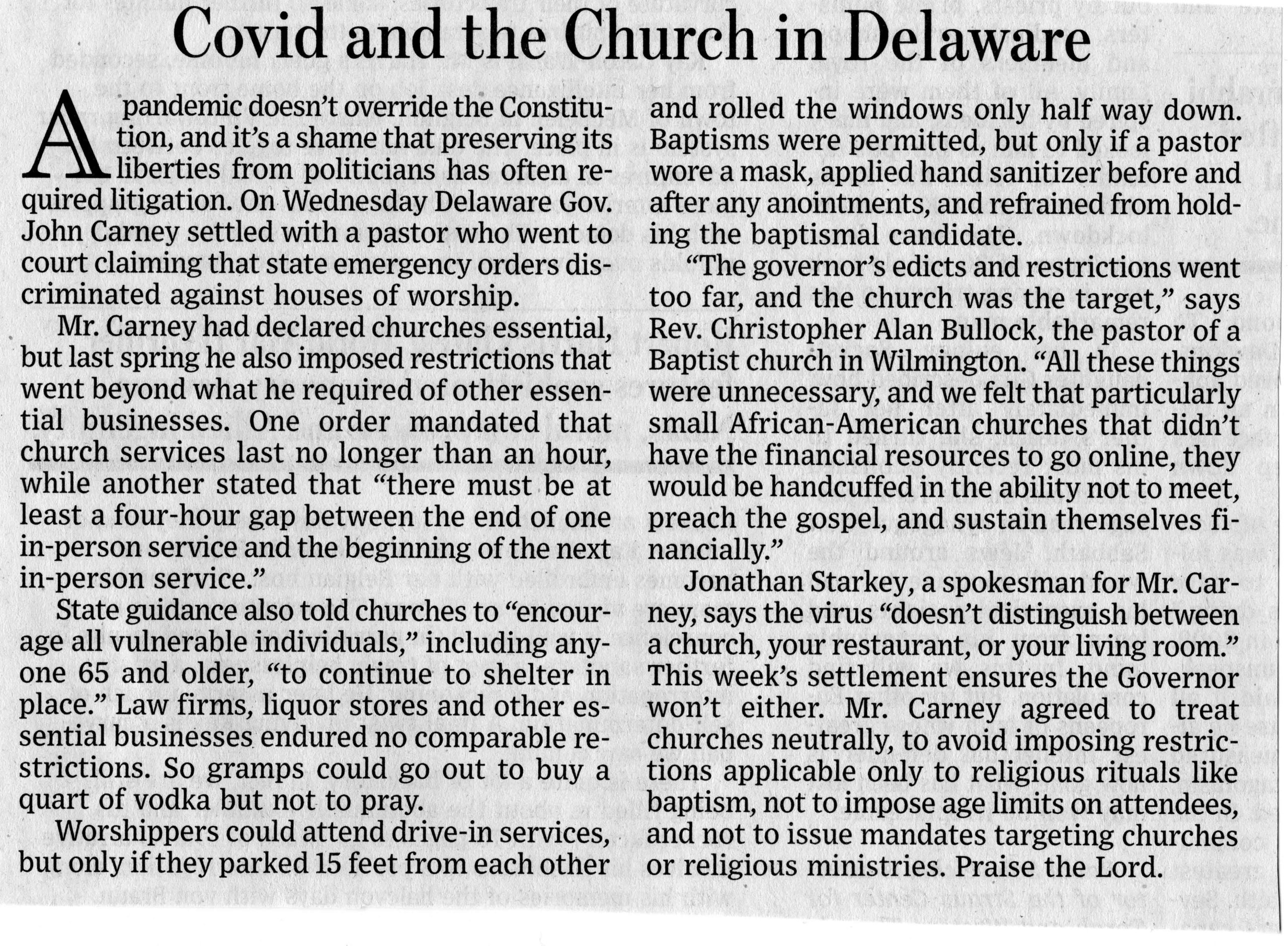
- In an editorial entitled “Covid and the Church in Delaware – Gov. Carney caves after he’s sued for targeting religious services,” the Editorial Board of the Wall Street Journal aptly exclaimed, “Praise the Lord.”
- As Rev. Dr. Bullock explained to the Wilmington News Journal, “It’s time to move on. We need to heal our country and heal our state and the Church of Jesus Christ stands on a sure foundation.”
- For more details about Governor Carney’s actions in closing down all religious worship in Delaware, see “the Nadir” section above.
Dobrich v. Walls, 380 F.Supp.2d 366 (D.Del. 2005) (in a case centering around prayer at school board meetings, representing school board member Reinald Helms, who refused to be represented by the school board’s attorney and instead brought in the Firm to ensure that his religious freedom rights were protected. The court here held that as an elected member of the school board, Mr. Helms received absolute legislative personal immunity from being sued, explaining that “opening a session of the legislature or other deliberative public body with a prayer is not a violation of the Establishment Clause” and that such a “practice is deeply embedded in the history and tradition of this country, and represents an unambiguous and unbroken history of more than 200 years.”).
Lt. Col. Martha McSally v. Donald Rumsfeld, C.A. No. 01-2481 (D.D.C. Dec. 3, 2001) (First Amendment Free Exercise and Fourteenth Amendment Equal Protection case on behalf of a decorated Lieutenant Colonel in her challenge to the requirement that female Air Force personnel wear the abaya and burqa when off base in Saudi Arabia, even when on official duty representing the United States government).
Liberty University v. The National Collegiate Athletic Association, C.A. No. 95-0046-L (W.D.Va. Sept. 1, 1995) (after the NCAA enacted a new rule banning and imposing penalties on college football players who took a knee after scoring a touchdown for a two second prayer, this federal action was filed on behalf of a private Christian university to protect its football players by striking down the new rule. The NCAA quickly backed down and rescinded its ban and penalties).
Presbytery of New Jersey v. Florio, 40 F.3d 1454 (3d Cir. 1994) (allowing a pastor’s legal challenge to an anti-discrimination public accommodations law to proceed because the State of New Jersey reserved the right to prosecute the pastor for his Bible based teachings on sexual immorality taking place outside the four walls of the church; while at the same time declining to allow the church’s own claims to proceed because the New Jersey Attorney General submitted an affidavit expressly representing that such state laws could not and would not ever be applied to religious speech taking place within the church).
O’Brien v. D.C. Armory Bd., 1994 WL 791974 (D.D.C. June 27, 1994) (granting a temporary restraining order on free speech grounds, barring interference with the display of religious and political signs at World Cup Soccer games at RFK Stadium in Washington, D.C.).
Aubrey v. City of Cincinnati, 815 F.Supp. 1100 (S.D. Ohio 1992) (in what the court described as a “case [that] combines three topics deeply ingrained in the hearts of many Americans—baseball, the Bible, and free speech,” striking down on free speech grounds a policy that barred a pastor’s “John 3:16” sign at the World Series on the grounds it was not in “good taste”); see Aubrey v. Cincinnati Reds, 841 F.Supp. 229 (S.D. Ohio 1993) (granting the same pastor summary judgment).
Stewart v. D.C. Armory Bd., 789 F.Supp. 402 (D.D.C. 1992) (granting a temporary restraining order and preliminary injunction on free speech grounds against a policy barring religious signs displaying “John 3:3” and “Mark 8:36” during NFL games at RFK Stadium in Washington, D.C.).
Thate v. D.C. Armory Bd., 804 F.Supp. 373 (D.D.C. 1992) (granting a consent decree barring RFK Stadium from taking down religious signs during NFL games).
Walter v. Board of Chosen Freeholders, C.A. No. 9104370 (D.N.J. August 12, 1992) (federal injunctive and compensatory relief for violation of the right to distribute religious literature in a public forum).
Mother Afr. Union First Colored Methodist Protestant Church v. Conf. of Afr. Union First Colored Methodist Protestant Church, 1991 WL 85846 (Del.Ch. May 16, 1991) (after the local bishop changed the locks to lock out the congregation, granting a preliminary injunction in favor of the congregation of this historic African-American church in a long running dispute with the local bishop and national conference over who owns and controls the church building); see also Mother African Union v. The Conference of African Union, 1992 WL 83518 (Del.Ch. April 22, 1992) (decision after trial in favor of the congregation), all affirmed Conf. of Afr. Union First Colored Methodist Protestant Church v. Mother Afr. Union First Colored Methodist Protestant Church, 633 A.2d 369 (Del. 1993), cert denied 510 U.S. 1025 (1993).
May v. Evansville-Vanderburgh School Corp., 787 F.2d 1105 (7th Cir. 1986) (viewpoint discrimination against religious speech).
Wood v. Pursey, C.A. No. 81-C-1282 (E.D. Wis. Dec. 29, 1981) (federal consent judgment limiting the right of the State to license a religious nursing home for the mentally disabled and to inspect it in areas beyond health and safety).
Walker v. First Orthodox Presbyterian Church of San Francisco, 1980 WL 4657 (Cal.Super. 1980) (successful action holding that a city code provision violated the Free Exercise Clause and infringed upon the rights of a local church and its members to freely exercise their religious beliefs).
Keegan v. University of Delaware, 349 A.2d 14 (Del. 1975) (successful action to force public university to allow students to use common areas of dormitories for religious worship), cert denied, 424 U.S. 934 (1976), rehearing denied, 425 U.S. 945 (1976).